

Video Marketing for Lawyers: 4 Short-Form Formats That Build Trust and Attention
Your next high-performing video probably will not look like a television commercial.
It may be a 45-second answer recorded at your desk. A reaction to a court decision. A visual walk-through of what happens after an accident. Or one sharp moment taken from a longer interview.
That is the opportunity in video marketing for lawyers: not to turn legal professionals into influencers, but to make their knowledge easier to understand, remember and trust.
Short-form video gives law firms a way to meet potential clients on TikTok, Instagram, LinkedIn, Facebook and YouTube before those people are ready to make contact. A useful video can answer an early question, correct a dangerous misconception or make an unfamiliar lawyer feel more approachable.
But the format matters. A strong legal point delivered in the wrong format can feel like a lecture. The same point, presented through a relatable situation or timely piece of commentary, can hold attention and start a meaningful conversation.
Below are four short-form video formats law firms can use to create clear, credible and repeatable content—without dancing, chasing every trend or buying a studio full of equipment.
Why short-form video belongs in a law firm marketing strategy
Legal services are high-trust purchases. Potential clients are not only asking, “Does this lawyer understand the law?” They are also asking:
- Does this person understand my situation?
- Can they explain a complicated issue clearly?
- Do they sound calm, credible and practical?
- Would I feel comfortable speaking with them?
Written content can demonstrate expertise. Video adds voice, expression and presence. It lets a prospective client experience how a lawyer communicates before booking a consultation.
That does not mean views are the only metric that matters. A million views from the wrong audience may be less valuable than 5,000 views from people in the right location, practice area and stage of need. Effective law firm video marketing should support business outcomes such as relevant website visits, qualified inquiries, consultation bookings, branded searches and professional referrals.
The best format is therefore the one that matches both the message and the audience.
1. The conversational reel: make one person feel understood

The conversational reel is the simplest place to begin.
Bring the camera closer, sit comfortably and explain one issue as if a client were sitting across from you. Do not perform like a television presenter. Speak naturally. Use your hands. Pause when you need to. Let the delivery feel human.
The goal is not perfection. It is relevance and connection.
What this format works best for
Conversational reels are ideal for frequently asked questions and early-stage concerns, such as:
- “Should I speak with the insurance company after a car accident?”
- “What should I bring to an initial family-law consultation?”
- “Can my employer change my role without my agreement?”
- “What is the difference between mediation and litigation?”
- “When should a business call a commercial litigation lawyer?”
Each video should answer one narrow question. If the subject needs five minutes of context, divide it into a series rather than rushing through a long answer.
A simple structure
Hook: Name the problem in the viewer’s language.
“Before you accept an insurance settlement, check these three things.”
Explanation: Give one useful principle, distinction or next step. Avoid turning the video into a complete legal seminar.
Boundary: Clarify that outcomes depend on the facts and jurisdiction when appropriate.
Call to action: Invite the viewer to read a related resource, save the video or contact the firm if they need advice about their own circumstances.
This is one of the most effective forms of lawyer video content because it reflects a skill clients genuinely value: the ability to make a difficult subject feel manageable. It can also reinforce a thoughtful personal brand for lawyers and legal professionals.
2. The immersive scenario reel: show the legal problem unfolding

Do not merely tell the audience what happens after a collision, dismissal, contract dispute or family breakdown. Put them inside the sequence.
An immersive scenario reel combines legal explanation with visual storytelling. The lawyer can narrate while the viewer sees relevant scenes, objects, documents or on-screen text.
For a personal injury topic, the sequence might include:
- The damaged vehicle
- The first call from an insurer
- A medical appointment
- A request for records
- An early settlement offer
For an employment-law video, it might show a calendar invitation, a meeting room, a termination letter and an unsigned package on a desk.
The audience is still learning the law, but the information now has context. Instead of listening to an abstract explanation, viewers can recognize the moment when the advice becomes relevant.
How to make a scenario reel credible
- Use a fictional or composite scenario rather than exposing a real client’s confidential information.
- Clearly label dramatizations where a viewer could mistake them for actual events.
- Keep the visual details realistic; credibility disappears when the scenario feels staged or sensationalized.
- Focus on the decision point. Show what the person should notice, document, avoid or ask next.
- Never imply that the same facts always produce the same legal outcome.
Immersive videos take more planning than a talking-head reel, but they are especially useful when timing, sequence or evidence matters. They can also become strong assets for practice-area pages, paid social campaigns and social media marketing for law firms.
3. The commentary reel: bring legal clarity to a conversation already happening
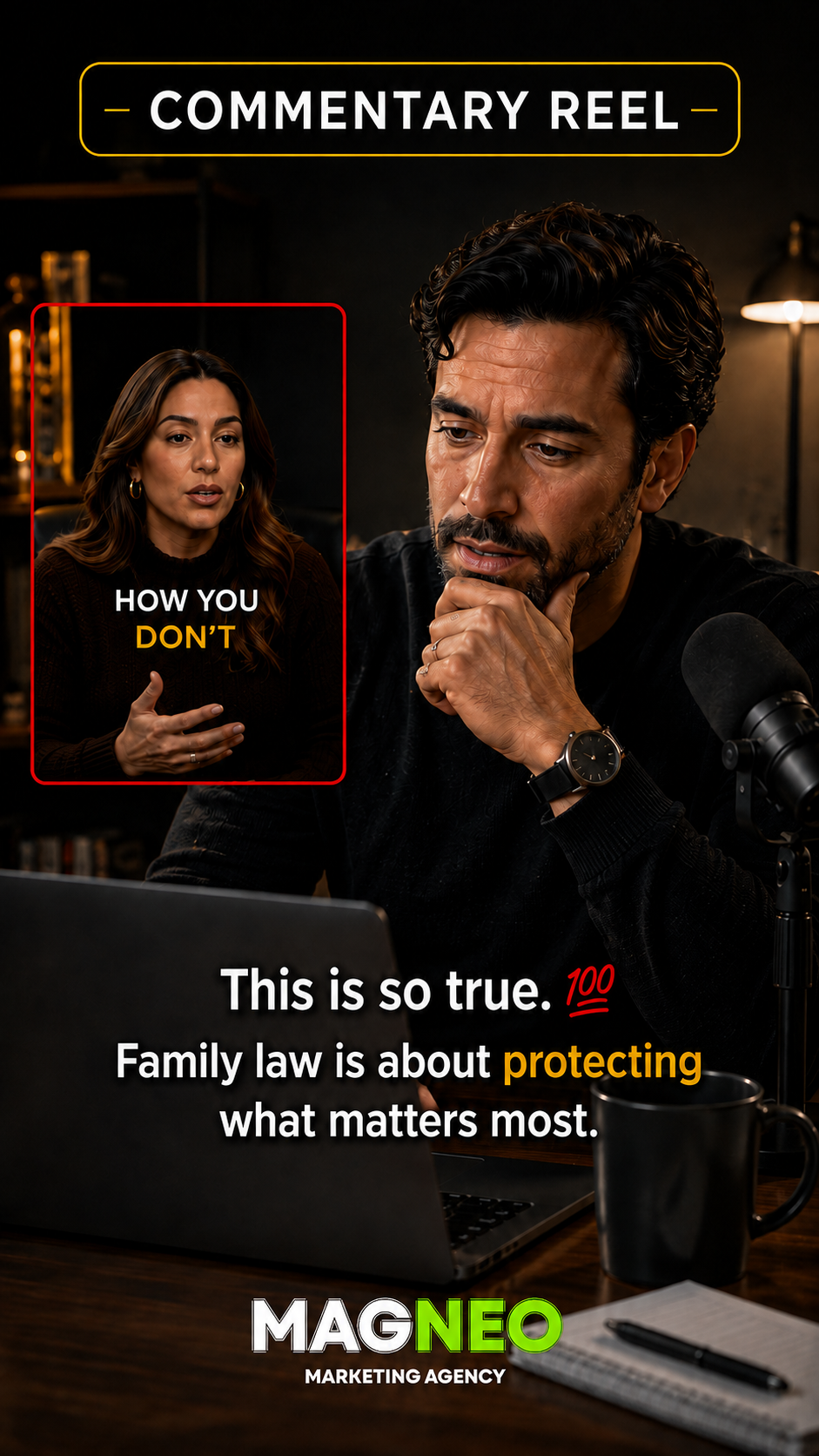
Lawyers do not always need to invent new content ideas. The public is already discussing court decisions, policy changes, workplace disputes, viral incidents and questionable legal advice.
A commentary reel begins with that existing conversation and adds qualified analysis.
The source material earns attention. The lawyer’s interpretation earns trust.
Possible starting points include:
- A newly released court decision
- A proposed change to legislation
- A news story with a misunderstood legal issue
- A viral clip that raises questions about consent, liability or employment rights
- A confident but misleading piece of “legal advice” circulating online
The strongest commentary does more than summarize. It identifies the point everyone is missing.
“This headline makes it sound as if the court created a new rule. It did not. Here is what the decision actually changes—and what it leaves untouched.”
Or:
“The video says an employer can never do this. The real answer depends on three facts that are not mentioned.”
A practical commentary structure
- State the claim or event. Give viewers enough context to follow the issue.
- Identify the misunderstanding. Explain why the popular interpretation is incomplete or wrong.
- Add the legal nuance. Clarify the relevant principle in plain language.
- Explain why it matters. Connect the issue to a real decision or risk.
- Point to a deeper resource. Link the video to an article, newsletter or practice-area page.
Speed matters with current events, but accuracy matters more. Confirm the underlying facts, work from primary sources whenever possible and distinguish allegations from findings. If a matter is ongoing, say so.
This format can be especially effective on LinkedIn, where professional audiences are already engaging with industry news and expert opinion. A structured LinkedIn growth strategy for law firms helps turn that attention into professional authority, referral relationships and business-development conversations.
4. The podcast or interview reel: turn one conversation into a content library
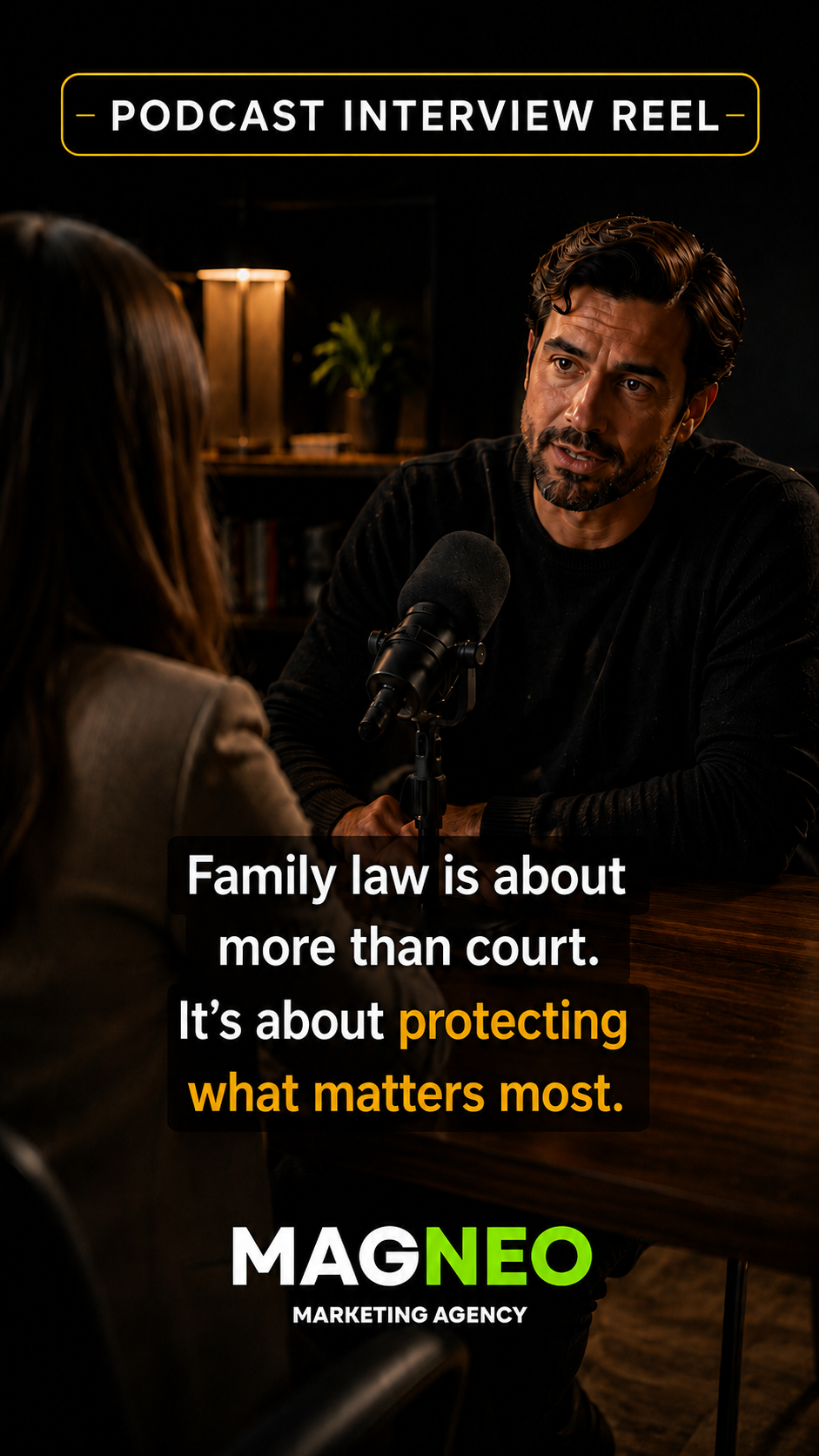
Two people, two microphones and one genuinely interesting question can generate weeks of short-form video.
The mistake is treating a 45-minute interview as a single piece of content. Most viewers will not begin with the full episode. They may, however, stop for one surprising answer, one client mistake, one useful story or one defensible opinion.
A single recorded conversation can produce:
- Several short vertical clips
- A full video episode
- An audio podcast
- A written Q&A or article
- Quote graphics
- A LinkedIn post or carousel
- An email newsletter
- An FAQ section for the firm’s website
The guest does not need to be another lawyer. Depending on the topic and professional rules, a firm might speak with a mediator, accountant, medical professional, investigator, HR leader, technology specialist or community organization.
Ask questions that create usable clips
Broad prompts often produce broad answers. Instead of “Tell us about employment law,” ask:
- “What is the most expensive mistake an employer makes during a termination?”
- “What do injured clients often do in the first 48 hours that makes their claim harder?”
- “What clause do business owners overlook until a dispute begins?”
- “What does the public consistently misunderstand about family mediation?”
Each question should be capable of producing a self-contained answer. During editing, remove the slow setup, add a clear headline and preserve enough context that the clip does not distort what the speaker meant.
How to choose the right format for the message
Use the format as a strategic decision, not a cosmetic one.
| If the message is… | Use this format |
|---|---|
| A direct answer to a common client question | Conversational reel |
| A process, timeline or moment of risk | Immersive scenario reel |
| A timely decision, news story or disputed claim | Commentary reel |
| A story, debate or specialist perspective | Podcast/interview reel |
The four formats can also work together. A commentary reel about a new decision can lead to a longer interview. That interview can produce conversational clips answering follow-up questions. A key fact pattern can then become an immersive scenario.
This is how a law firm moves from isolated posts to a sustainable legal content marketing system.
A practical production system for busy lawyers
Consistency becomes easier when the work is batched.
Start with four client questions and one timely issue. Record the conversational answers in one sitting. Film one simple scenario while the camera and lighting are already set up. Then record a 20- to 30-minute interview built around three focused questions.
From one production block, the firm may have enough raw material for several weeks of short-form video.
For each clip:
- Open with a specific problem or tension—not a long introduction.
- Put the key point in the first few seconds.
- Use captions, because many people encounter social video without sound.
- Keep on-screen text large, accurate and easy to scan.
- Remove pauses that slow the idea, but do not edit the statement in a way that changes its meaning.
- Adapt the caption and call to action for the platform instead of posting identical copy everywhere.
- Send interested viewers to a relevant page, not automatically to the homepage.
Instagram Reels and TikTok can help a firm reach people through interest-driven discovery. LinkedIn video can support professional authority, referral relationships and business-development conversations. Facebook can extend local and community reach. YouTube Shorts can complement longer educational videos and search-led content.
The subject may stay the same, but the packaging should reflect why people use each platform. A coordinated SEO strategy for law firms can help the resulting videos and articles keep generating qualified discovery beyond the initial social post.
Legal marketing compliance: build review into the workflow
Every jurisdiction has its own professional rules, and a social post can still be considered lawyer advertising. Before publishing, confirm the requirements that apply to the lawyer, firm, audience and platform.
As a general review checklist:
- Do not make false, misleading or unverifiable claims.
- Avoid guarantees, unjustified expectations and language suggesting a particular result is certain.
- Do not disclose confidential or identifying client information without valid authorization.
- Confirm that testimonials, case results and specialist claims are permitted and properly qualified.
- Distinguish general legal information from advice about a viewer’s specific matter.
- Check whether the post requires an advertising label, lawyer identification, office location or jurisdiction-specific disclaimer.
- Obtain permission for third-party footage, music, images and other copyrighted material.
- Keep a record of the approved script, source material, reviewer and publication date.
The American Bar Association’s guidance on attorney advertising and ethics in the digital age explains that digital marketing remains subject to professional-conduct rules and that delegating marketing work does not remove a lawyer’s compliance responsibilities. In Ontario, the Law Society of Ontario Rules of Professional Conduct address lawyer marketing under Rule 4.2. Firms should use the rules and guidance applicable to every jurisdiction in which the content may be considered advertising.
A disclaimer is not a cure for misleading content. Compliance needs to begin with the concept and script, then continue through editing, captions, claims, calls to action and distribution.
Measure business value—not vanity alone
Views matter because they indicate distribution, but they do not tell the whole story.
Attention: reach, watch time, completion rate and replays
Trust: saves, shares, profile visits, branded searches and meaningful comments
Action: visits to a relevant service page, qualified inquiries, booked consultations and referral conversations
Over time, compare formats and topics. You may find that commentary earns the widest reach, conversational videos generate the most saves and scenario reels drive the most visits to a practice-area page.
That information should shape the next production cycle.
You do not need to become an influencer
The best short-form video for lawyers does not ask legal professionals to abandon their credibility. It makes that credibility more accessible.
Speak like a lawyer speaking to a real person. Show the moments in which legal guidance matters. Add calm analysis to noisy conversations. Capture strong ideas from longer discussions and give each one room to travel.
The goal is not to look perfect or chase virality at any cost. It is to become recognizable, useful and trusted before a prospective client needs to make a decision.
And if one of those videos reaches a million people, excellent. Just make sure the right people know what to do next.
Build a repeatable video strategy for your law firm
If your firm wants to create credible short-form video but does not know what to film, how to structure it or how to turn it into a consistent content system, Magneo can help.
We develop compliance-aware legal marketing strategies, content formats and distribution systems designed around your practice areas, audience and business goals.
Request a law firm marketing audit
Frequently Asked Questions
What kind of videos should lawyers make?
Lawyers can create conversational FAQ videos, immersive legal scenarios, commentary on decisions or news, and short clips from interviews or podcasts. The best format depends on whether the message is an answer, a process, a timely analysis or a story.
How long should a law firm’s social media video be?
A video should be only as long as needed to deliver one useful idea clearly. Many short-form clips can work within 30 to 90 seconds, but clarity and viewer retention matter more than forcing every topic into a fixed duration.
Do lawyers need professional equipment for video marketing?
Not necessarily. A current smartphone, clear audio, stable framing and good natural or basic continuous lighting can be enough for conversational content. More complex scenario, interview or brand videos may benefit from professional production.
Which social media platform is best for lawyers?
It depends on the audience and objective. LinkedIn can support professional authority and referrals; Instagram, TikTok and YouTube Shorts can support broader discovery; Facebook can help with local and community visibility. Firms should choose platforms based on where their intended clients and referral partners actually spend attention.
Can lawyers use TikTok and Instagram Reels for marketing?
Yes, subject to the professional-conduct, advertising, privacy and intellectual-property rules that apply in the lawyer’s jurisdiction. The platform does not remove the lawyer’s responsibility for the accuracy and presentation of the content.
Does a legal video need a disclaimer?
Requirements vary by jurisdiction and content. A firm should review applicable professional rules and obtain jurisdiction-specific guidance. A disclaimer can clarify the nature of general information, but it does not make false or misleading content acceptable.
- On September 2, 2026

Leave Reply